


Introduction
On 1 January 2021, the European Commission harmonized civil drone regulations across the following countries: European Union’s 27-Member States + Iceland, Lichtenstein, Norway, Switzerland (process ongoing), and United Kingdom (partially).
The regulations require all operators of drones above 250 g to register with their country’s National Aviation Authority (NAA). This can be where the operator lives or at their principal place of business. This registration is valid for the period defined by the NAA.
Once registered, the operator receives a registration number that must be displayed on all its drones and uploaded onto the remote identification system. This number is recognized in all European Union member states.
In this blog post, you’ll find detailed information on current European drone regulations.
Overview of the current European drone regulations
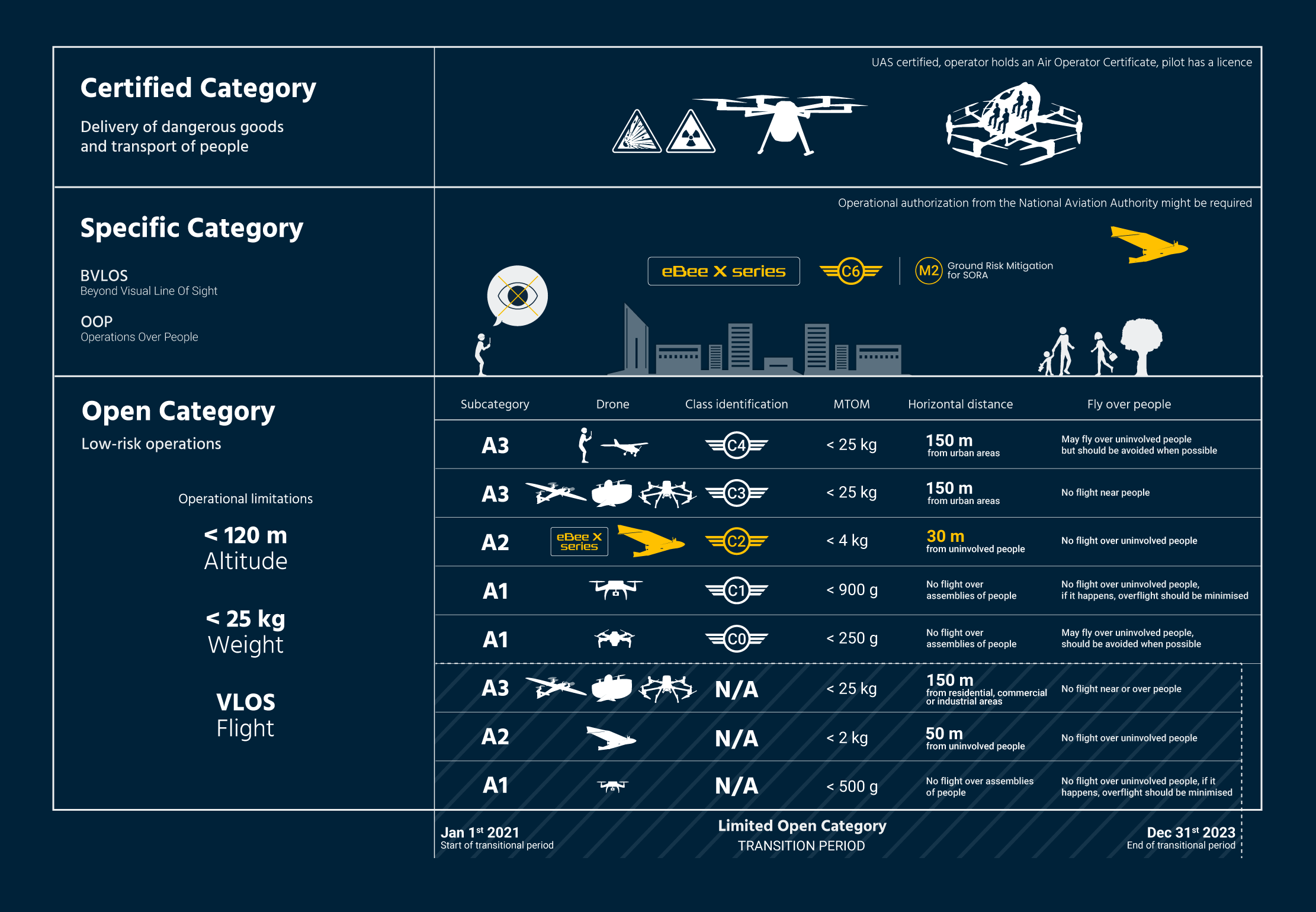
The European regulatory framework (2019/945 and 2019/947) takes an operation risk-based approach, which considers the drone’s weight, technical and safety specifications and the type of operation being conducted.
There are three categories of drone operations in the EU regulations:
Certified Category
- High-risk operations: like the delivery of dangerous goods with a drone or flying taxis.
- Required: Operational authorization from the NAA.
Specific Category
- Advanced operations: EVLOS, BVLOS, OOP, package delivery, and more.
- Flights pose a level of risk not covered under the Open Category.
- Four operation procedures to obtain approvals: Specific Operation Risk Assessment (SORA), Predefined Risk Assessment (PDRA), Standard Scenario (STS) or Light UAS Operator Certificate (LUC).
- Required:
- For STS: drone bearing a C5 or C6 class identification label + operator just submits an operation declaration.
- For SORA, PDRA and LUC: Operational authorization from the NAA.
Open Category (including transitional Limited Open Category)
- Low-risk operations: max. altitude 120 m above ground level (AGL), VLOS flights and drones under 25 kg.
- Applies to most drones that do not transport goods and do not conduct advanced operations.
- Not required: Operational authorization from the NAA.
- Composed of:
- Limited Open Category: Transition period from January 2021 until December 2023 to give manufacturers time to certify their drones for the Open Category. Based on the drone’s maximum take-off weight (MTOW).
- Open Category: The drone entries this category once assessed by a Notified Body and granted with one of the class identifications C0, C1, C2, C3, C4. Based on the drone’s maximum take-off weight (MTOW) + technical and safety specifications.
- Open Category is subdivided into:
- Operational subcategories: A1, A2, A3, indicating flight limitations for the drone.
- Drone class certifications: C0, C1, C2, C3 and C4, indicating drone’s weight and related specifications. The higher the class number, the greater the operational limitations.
